
U.S. Army Corps Tries to Hide Analysis for Risky Decision to Drain Lake from the Court, Marion County, and the Public
SALEM, OR — In the ongoing lawsuit Marion County filed against the U.S. Army Corps of Engineers to stop the draining of Detroit Lake, the Army Corps made an astounding claim: That their administrative record, which is the foundation of their review and decision to drain the lake, shouldn’t be seen by the Court or Marion County before the judge determines whether they can move forward with their potentially catastrophic plan this fall. The Army Corps is also trying to avoid answering questions on basic issues in the case.
Marion County has objected to the Army Corps’ effort to avoid transparency.
“Marion County allowed Federal Defendants to defer their responses to most document requests,” a response from County Counsel to the Court stated. “The County only requested the administrative record related to the decision to perform a deep drawdown at Detroit Lake (RFP Request No. 2) and responses to requested admissions.
“Federal Defendants’ emphasis on the importance of the administrative record undermines their claim that they do not need to provide it to plaintiffs and the Court. Given that this is the foundational document or set of documents for this case, it is eminently reasonable to request this.”
“It’s surprising to me that the Army Corps’ best defense for their own plan to drain the lake is to hide their own analysis and reasoning for draining the lake,” said Commissioner Kevin Cameron. “To go before a judge and ask them to agree to your arguments while hiding your own analysis is patently absurd and further shows that the Army Corps doesn’t trust their own decision.”
The Court will consider arguments regarding this issue at the next hearing in the case, which is October 6, 2026.
“If Federal Defendants are confident they made the correct decision, then they should not fear transparency on how they reached their decision,” the County’s response said.
Background
Marion County filed a lawsuit on May 13, 2026, asking the United States District Court to order the U.S. Army Corps of Engineers to pause efforts to drain Detroit Lake until the Army Corps completes the turbidity report required by federal law and allows informed public comments. Congress required the Army Corps to evaluate lessons learned from turbidity problems caused by a similar draining of nearby Green Peter Lake, but the Army Corps was over four months past the legal deadline.
On August 11, 2026, Marion County filed a motion outlining the many ways federal defendants violated the law in adopting their new policy of annual deep drawdowns of Detroit Lake. This new policy will devastate canyon communities, endanger drinking water for over 230,000 people living downstream, and even jeopardize the very fish it claims to be trying to save.
Catastrophic Damage from Similar Drawdown at Green Peter Lake
In 2023, a court order forced similar deep drawdowns at nearby Green Peter Lake due to a lawsuit from an environmental group. This killed thousands of salmon and caused massive increases in turbidity that harmed downstream water systems.
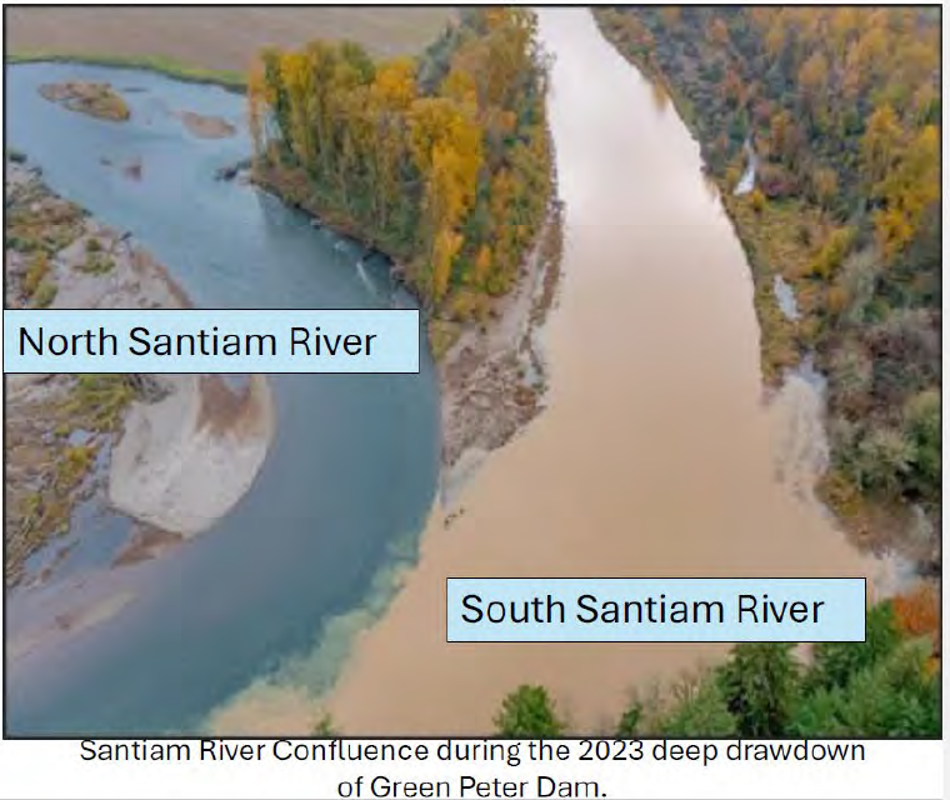
Photo Credit: Brian Stone Photography LLC; explanatory text added by public commenter who submitted it during SEIS process.
The new policy of annual deep drawdowns would drain the lake below its minimum conservation pool—to its lowest historic level in the first year and to even deeper untested low levels each fall in following years. Dropping water levels in this manner disturbs fine sediment on the lake bottom and causes turbidity (dirty water), which harms all fish and municipal water systems downstream. There would also be water shortages if there is low rain that prevents refill, hurting cities and agriculture. The damage that was caused by the deep drawdown of Green Peter shows a deep drawdown of Detroit could also kill much of a lake’s fish population. All this would harm the tourism-based economy of the local community.
“Risking the drinking water of our communities while harming thousands of fish is patently absurd” said Commissioner Willis. “Since the Army Corps refused to listen to reasonable requests from the county, cities, and schools, this lawsuit is the strongest means we have to protect our downstream communities as well as recreation at Detroit Lake”
The Army Corps’ own analysis found that the level of low rain that causes water shortages when combined with a deep drawdown occurs one out of every four years. This year will almost certainly be one of those years. The National Oceanic and Atmospheric Administration (NOAA) is predicting an “81% chance of a very strong El Niño during October-December of 2026 that would rank among the largest El Niño events in the historical record going back to 1950” and “a 97% chance” that El Niño conditions “will persist through early spring 2027.”
“Our residents depend on clean, reliable drinking water,” said Commissioner Kevin Cameron. “The Army Corps should not be gambling with the safety of drinking water in our community.”
“Water management must be grounded in data-backed science with meaningful protections in place for our communities,” said Commissioner Danielle Bethell. “The Army Corps is defying common sense and has not committed to any meaningful safeguards, which is why we will continue this fight to protect our residents from the Army Corps’ devastating policies.”