
Marion County Makes Its Case in Federal Court to Stop Detroit Lake Drawdown
SALEM, OR — A coalition of Marion County, the City of Salem, the City of Stayton, and the Santiam Water Control District made their case in federal court today, asking the U.S. District Court to halt the U.S. Army Corps of Engineers’ plan to drain Detroit Lake below its minimum conservation pool this fall. Their arguments centered around concerns of harm to water for drinking, firefighting, and agriculture for more than 220,000 downstream residents. After hearing arguments from all sides, U.S. District Judge Mustafa T. Kasubhai took the matter under advisement and is expected to issue a ruling in the coming weeks.
“We made our case today, and we made it clearly: the Army Corps is moving forward with a catastrophic plan without safeguards for the people who depend on this water,” said Commissioner Colm Willis, Chair. “Whatever the outcome, we will keep using every tool available to protect our residents, our water, and our local economy.”
Marion County will provide an update once the Court issues its decision.
Background
Marion County filed a lawsuit on May 13, 2026, asking the United States District Court to order the U.S. Army Corps of Engineers to pause efforts to drain Detroit Lake until the Army Corps completes the turbidity report required by federal law and allows informed public comments. Congress required the Army Corps to evaluate lessons learned from turbidity problems caused by a similar draining of nearby Green Peter Lake, but the Army Corps was over four months past the legal deadline.
On August 11, 2026, Marion County filed a motion outlining the many ways federal defendants violated the law in adopting their new policy of annual deep drawdowns of Detroit Lake. This new policy will devastate canyon communities, endanger drinking water for over 230,000 people living downstream, and even jeopardize the very fish it claims to be trying to save.
Catastrophic Damage from Similar Drawdown at Green Peter Lake
In 2023, a court order forced similar deep drawdowns at nearby Green Peter Lake due to a lawsuit from an environmental group. This killed thousands of salmon and caused massive increases in turbidity that harmed downstream water systems.
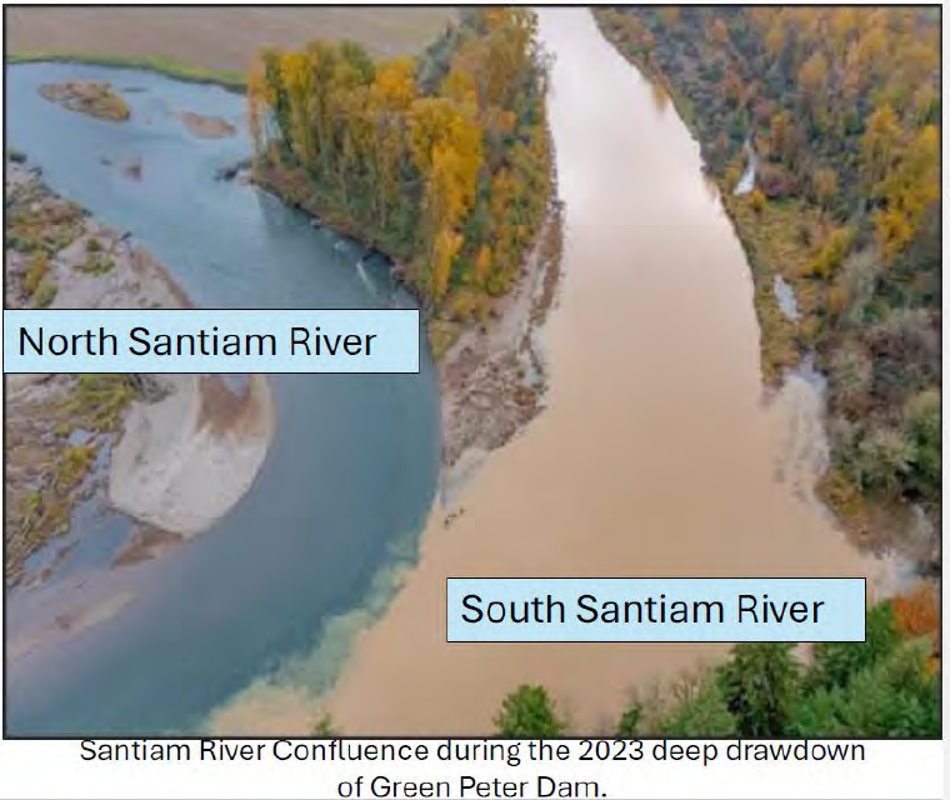
Photo Credit: Brian Stone Photography LLC; explanatory text added by public commenter who submitted it during SEIS process.
The new policy of annual deep drawdowns would drain the lake below its minimum conservation pool—to its lowest historic level in the first year and to even deeper untested low levels each fall in following years. Dropping water levels in this manner disturbs fine sediment on the lake bottom and causes turbidity (dirty water), which harms all fish and municipal water systems downstream. There would also be water shortages if there is low rain that prevents refill, hurting cities and agriculture. The damage that was caused by the deep drawdown of Green Peter shows a deep drawdown of Detroit could also kill much of a lake’s fish population. All this would harm the tourism-based economy of the local community.
The Army Corps’ own analysis found that the level of low rain that causes water shortages when combined with a deep drawdown occurs one out of every four years. This year will almost certainly be one of those years. The National Oceanic and Atmospheric Administration (NOAA) is predicting an “81% chance of a very strong El Niño during October-December of 2026 that would rank among the largest El Niño events in the historical record going back to 1950” and “a 97% chance” that El Niño conditions “will persist through early spring 2027.”